“The word accounting comes from the word accountability. If you are going to be rich, you need to be accountable for your money.” – Robert Kiyosaki
Accounting is used in a variety of modern economic and business contexts. Accountants help companies of all sizes create strategic plans to maximize success and limit chances of failure. Without accounting, it would be very difficult for businesses to analyse their financial performance, which would make it even harder for organisations to make smart decisions for the future.
In Cambridge IGCSE Accounting, learners focus on the skills of recording, reporting, presenting, and interpreting financial information. These form an ideal foundation for further study and for a future career within the accounting profession.
Career prospects available in accounting are diverse. Learners could become chartered accountants and open their own firms, offering accounting services to various businesses, or work within consulting practice firms and other financial institutions.
Accountants are trusted professionals with integrity. They are known for being organised, logical, and rational. People often look up to accountants for sound business advice.
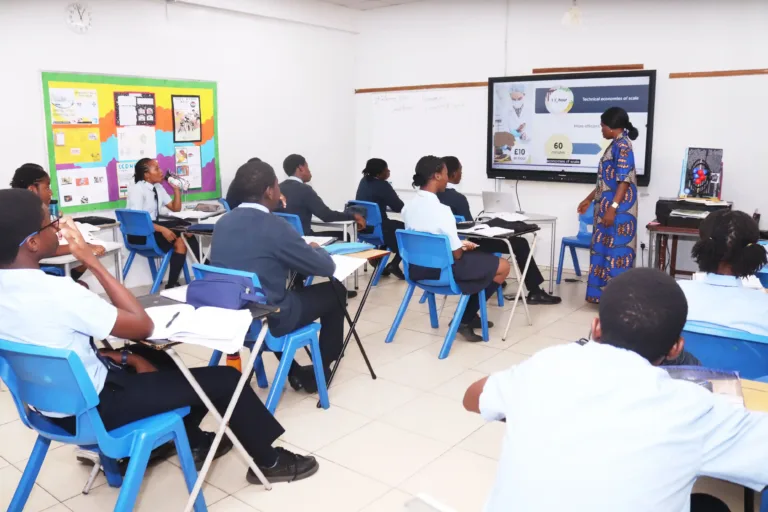
Learners are exposed to all elements of these tenets in the Accounting course taught at Grange School. We also teach learners how to make sound decisions that are in the best interests of the organisations they may work for, or in self-employment.
Business Studies is a subject that embraces areas such as Accounting, Marketing, and Economics. It is a course of study that teaches the full range of principles of business management. The subject builds a strong foundation for those who wish to move on to further study (A-Levels and university) and training in specialised areas such as management, international business, marketing, accounting, information and communication technology, or entrepreneurship. It also provides practical skills for those who wish to move directly into the workplace.
Business Studies at Grange School develops learners’ understanding of business activity in the public and private sectors, and the importance of innovation and change. Learners discover how the major types of business organisation are established, financed, and run, and how their activities are regulated. Learners not only study business concepts and techniques but also develop related skills such as numeracy and enquiry. Factors influencing business decision-making are considered, as are the essential values of teamwork and interdependence.
Ultimately, all learners—after graduation from whichever field of learning—will encounter the world of business, whether they work in urban or rural areas. Businesses affect the daily lives of people as they work, spend, save, invest, travel, and play. They have a significant influence on the standard of living and quality of life, as well as on the environment in which people live.
Engaging in the world of business activities involves studying individuals, communities, and organisations, assessing their needs and problems, and generating solutions. Learners should therefore be prepared with the confidence and competence required to do so. Young people need to understand how businesses function, the role they play in society, the opportunities they generate, the skills required, and the impact they have on their lives and on society, both today and in the future.
“A people without the knowledge of their past history, origin and culture is like a tree without roots” – Anonymous.
History is pivotal in every environment as it helps people understand why they interact with each other. It enquires into the motivation of human actions, the course of those actions, the consequences of those actions, and the assessment of their importance. It also helps in improving the understanding of human behaviour.
The study of History as a subject cannot be overemphasised as it helps people to carry out enquiries independently with the aim of reaching a balanced conclusion that is devoid of bias, but based on evidence through effective communication. History aids and encourages oral expression and the needed confidence in times of debating over an issue, locally or internationally. It is a subject that encourages individuals to be more tolerant of each other.
History at IGCSE focuses on key events and periods from the 20th Century and an in-depth study of Germany (1918–1945). The emphasis is on both historical knowledge and on the skills required for historical research. Pupils develop an understanding of the nature of cause and effect, continuity and change, similarity and difference, and learn how to use and understand historical evidence as part of their studies. IGCSE History will stimulate any pupil already interested in the past, providing a basis for further study and encouraging a lifelong interest in the subject.
🔒 Privacy Notice
×
This website uses cookies to improve your experience. By using this website, you agree to our Privacy Policy .